Finished basements
The most popular home for metallic. It adds almost no height, has no seams for damp to get under, and lighter pearls and silvers bounce light around a room with small windows.
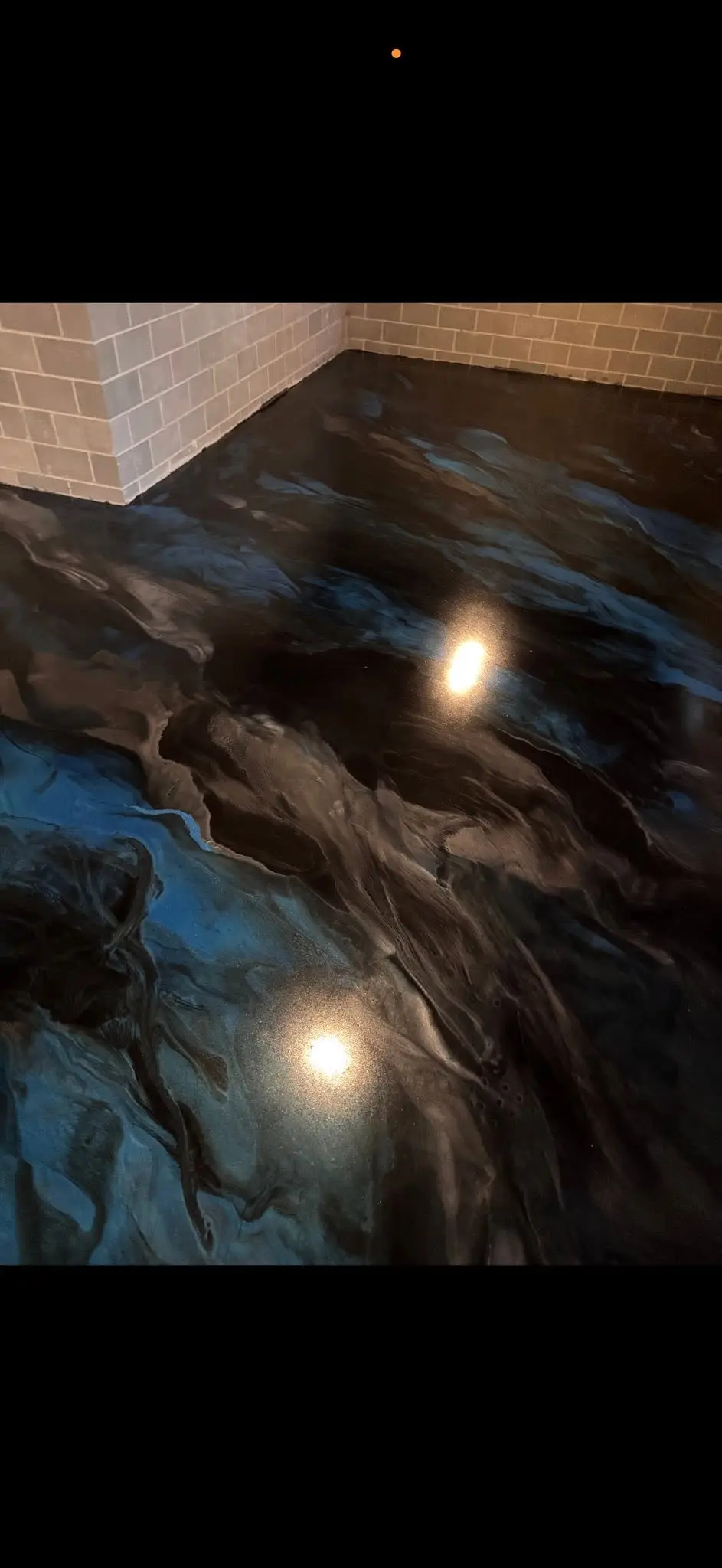
Shown: pearl and grayMetallic pigment suspended in clear epoxy, poured and worked by hand into swirls, veins and depth that read like marble or molten metal. No two floors come out alike. Built for finished basements, showpiece garages, showrooms and any room where the floor should be the first thing people notice.
The background is a live illustration. Every pour lands differently, which is exactly how the real floor behaves.
A metallic epoxy floor is a seamless, high-gloss concrete coating made by mixing fine metallic pigment into clear epoxy and pouring it over a colored base coat. While the epoxy is still liquid, the installer moves the pigment by hand so it settles into swirls, veins and pools that look like marble, water or molten metal. The pattern forms as the floor cures, so no two are ever the same.
JDS Concrete Coatings installs metallic epoxy floors across Northeast Ohio, including Canton, Massillon, North Canton, Jackson Township, Green and Akron. Every one starts with diamond-ground concrete and a moisture-vapor-barrier base coat, and finishes under a clear, UV-stable polyaspartic topcoat.
Metallic is the best-looking floor we install and the least forgiving one to live with. We would rather tell you that now than after it is down.
Five kinds of rooms where we see metallic flooring do its best work around Stark and Summit counties.
The most popular home for metallic. It adds almost no height, has no seams for damp to get under, and lighter pearls and silvers bounce light around a room with small windows.
Shown: pearl and grayFor the garage that is kept as clean as the house: a home gym, a games room, a finished hangout. If the garage works for a living, go flake.
Shown: black and blueCoppers and bronzes warm up a room the way stained concrete used to, with far more depth, and spills wipe straight off the sealed surface.
Shown: copper and bronzeShops, salons and showrooms get a floor customers photograph. It is seamless and easy to keep presentable, and the fast-curing topcoat keeps closed-door time short.
Shown: charcoal and silverA first impression that does not look like every other polished-concrete lobby. Entry mats handle the grit, and the floor handles the rest.
Shown: black and goldSwipe sideways to see all five.
Nothing is printed, stamped or stenciled. The pattern comes from how liquid epoxy moves, and from the installer knowing when to push it and when to leave it alone.
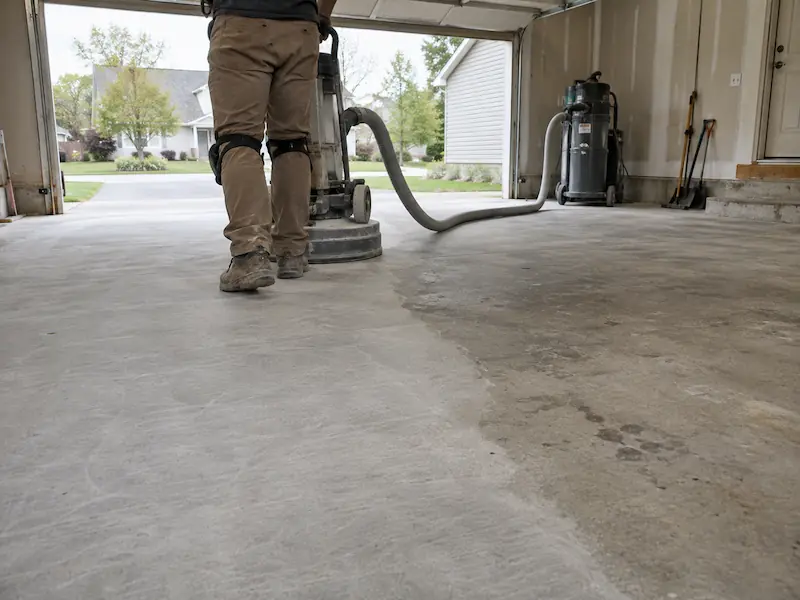
The slab is diamond-ground and every crack, pit and ridge is repaired and ground flush. Prep matters on any coating. On a mirror-gloss floor it matters more, because light rakes across the surface and shows anything left behind.
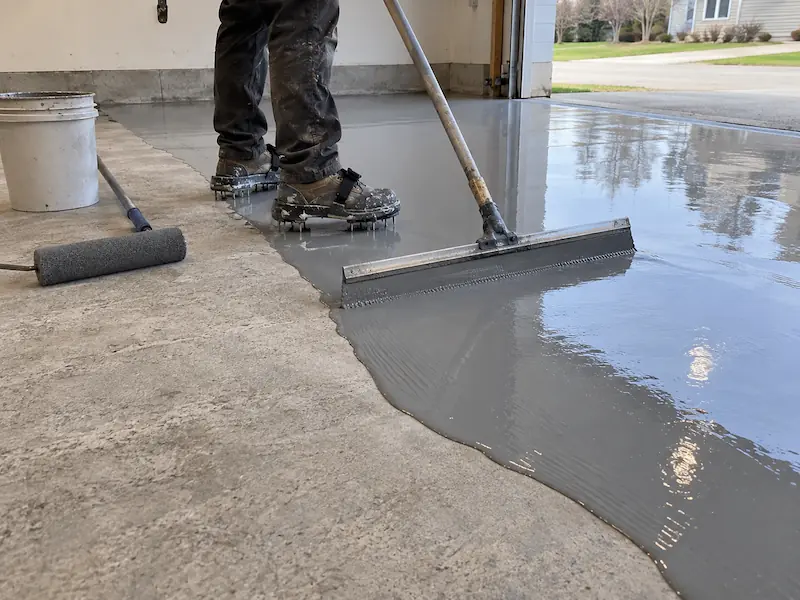
A pigmented, moisture-vapor-barrier epoxy base coat goes down first. It seals the concrete and sets the background the metallic sits on. A dark base gives the most depth, and a light base gives a softer, pearlier floor.
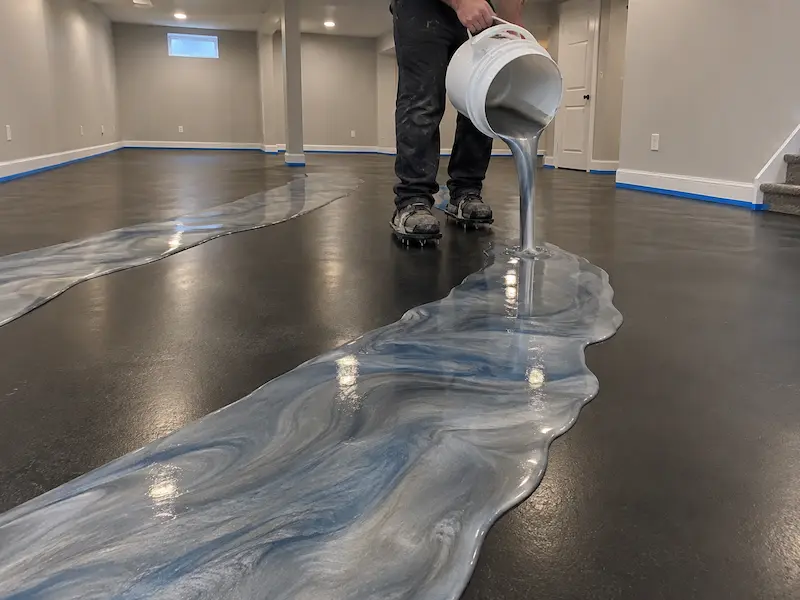
Clear epoxy loaded with metallic pigment is mixed in small batches and poured in ribbons across the floor, often in two or three colors at once, then spread to an even depth.
This is the craft. Rollers, brushes, moving air and a light mist of solvent are used to pull the pigment into veins, ripples and craters. The epoxy keeps drifting and leveling for a while after the tools are down, which is why no one can promise an exact pattern.
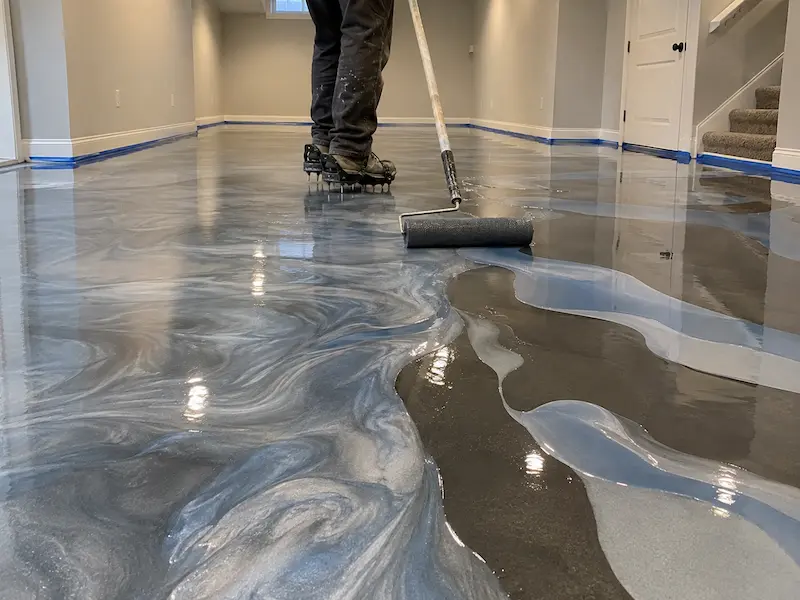
Once the metallic layer has cured, a clear polyaspartic topcoat goes over it. That is the layer you actually walk on. It takes the wear, keeps the gloss, resists UV yellowing, and can carry a grip additive where you need it.
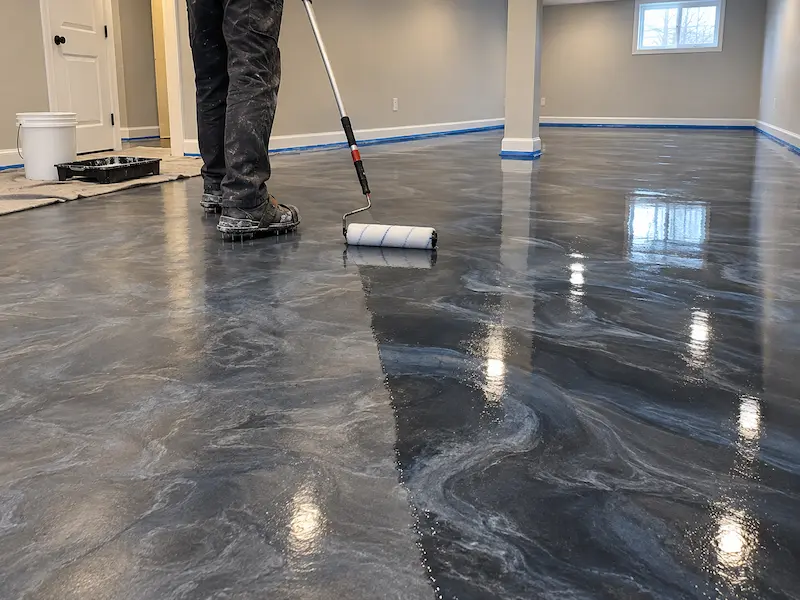
The most common surprise with metallic flooring is how much of the final look is left to the material. Here is the honest split.
A metallic floor is tough. It is also glossy, and gloss shows what flake hides. Three habits make the difference.
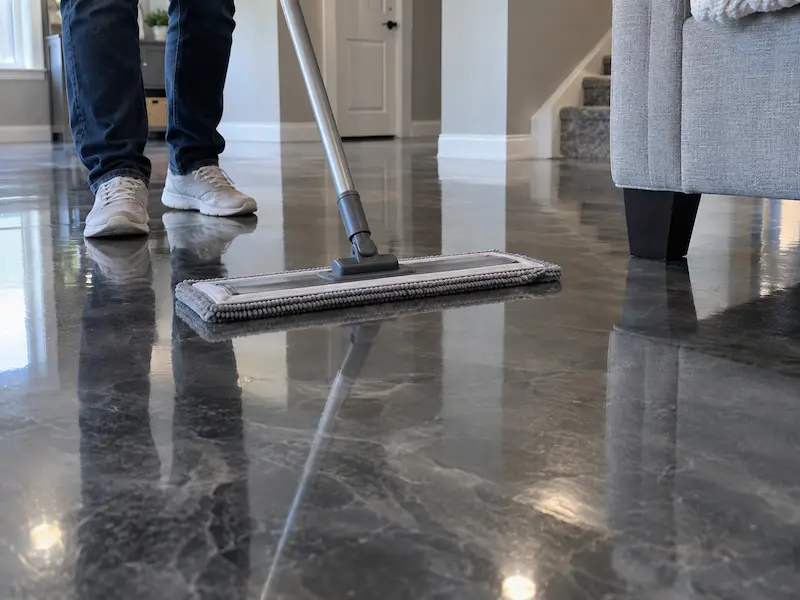
A dry microfiber mop lifts fine grit instead of dragging it across the gloss. When the floor needs more, use warm water and a pH-neutral cleaner. Skip vinegar, citrus and anything abrasive, which dull a gloss topcoat over time.
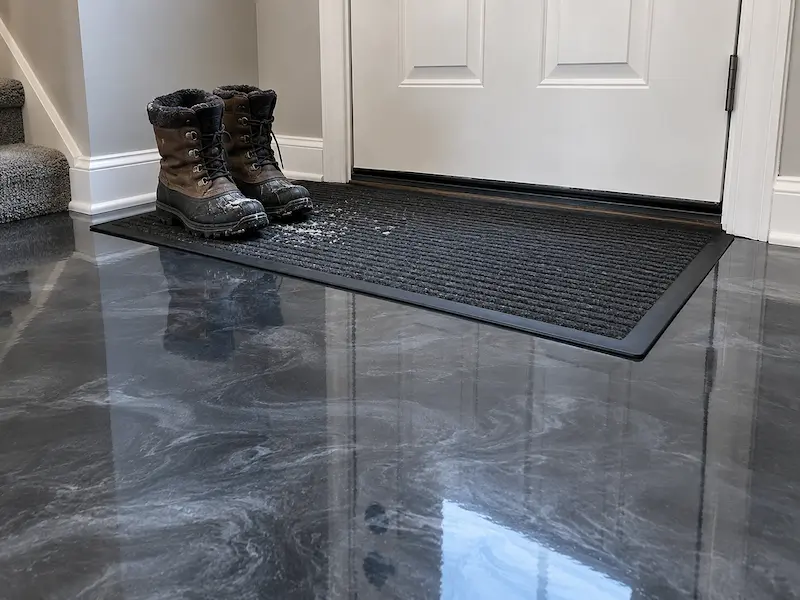
Most fine scratches come from grit carried in on shoes. In a Northeast Ohio winter that includes road salt, so let the mat catch it before the floor does.
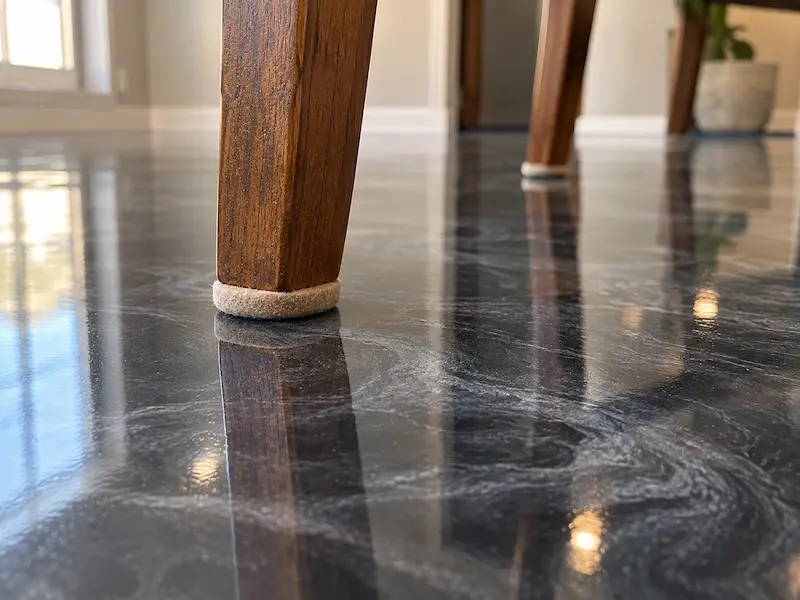
Pads under chair and table legs, and lift rather than drag. If the gloss ever dulls, the clear topcoat can usually be renewed without redoing the floor.
Photos only go so far with a floor that changes as you walk across it. Look through our recent metallic work online, then ask us at your quote about seeing samples in person.
Rated 5.0 by local customers on Google
JDS Concrete Coatings is based in Canal Fulton, between Massillon and Akron. Metallic epoxy suits the finished basements of Jackson Township, North Canton and Green, the rec rooms and home bars going into older Canton, Massillon and Akron homes, and storefronts, salons and offices from the Belden Village area to Lincoln Way in Massillon.
Being local matters more with metallic than with any other finish. It is a floor you should see samples of in your own light, talk through in person, and be able to call someone about years later.
Close by but not listed? Call (330) 575-5513 and we'll tell you right away whether we can get to you.
When dry, no more than any other smooth, sealed floor. When wet, a high-gloss metallic floor can be slick, because it has none of the texture a flake or quartz floor has. A fine grip additive can be mixed into the clear topcoat to improve traction with very little change to the look. Tell us at your quote if the floor will see water regularly.
You choose the colors, the base color and the overall movement, from soft and marbled to bold and veined. The exact placement of each swirl cannot be chosen, because the epoxy keeps flowing and leveling after the installer stops working it. That is also why no two metallic floors are alike.
The clear polyaspartic topcoat is hard and abrasion resistant, so the floor itself holds up well. What is different is that a mirror-gloss surface shows fine scratches and dust more readily than a textured flake floor does. Entry mats, felt pads and a microfiber dust mop prevent most of it, and a dulled topcoat can usually be renewed.
It is a great choice for a showpiece garage that is kept clean. For a garage that sees daily grit, road salt, tools and projects, a full-broadcast epoxy flake floor is the better pick, because its texture grips when wet and its pattern hides dust and wear. JDS installs both and will tell you honestly which suits how you use the space.
Yes. Finished basements are the most popular place for metallic epoxy. It adds almost no floor height, has no seams or grout, and lighter metallics brighten a room with small windows. Because basement slabs sit below grade, the floor starts with a moisture-vapor-barrier base coat, and any active water problem needs to be fixed first.
Most metallic floors are installed over 1–2 days: grinding, repairs and the base coat first, then the metallic pour, then the clear topcoat once the metallic layer has cured. We give you exact walk-on and move-back-in times for your floor at install, since cure time depends on temperature and humidity.
Epoxy on its own can amber with years of direct sunlight, which shows most on white and pearl floors. JDS seals metallic floors under a UV-stable polyaspartic topcoat to protect against it. For rooms with large south-facing windows or doors, we will steer you toward colors that stay truest.
Metallic is the most labor-intensive finish we install, so it generally costs more than a flake floor of the same size. The final figure depends on square footage, how much slab repair and leveling is needed, and how many colors go into the pour. JDS measures and inspects the floor in person and gives you a fixed quote. On-site quotes are free and there is no obligation.
A professionally installed metallic epoxy floor over diamond-ground concrete is built to last for years, and JDS backs it with a written 4–5 year warranty. DIY metallic kits often fail within 1–3 months, usually because the concrete was never ground and no moisture barrier went down first.
We'll measure the space, check the concrete, go through colors in your own light, and tell you straight whether metallic is the right call. The quote is fixed and free.
Mon–Sat, 7am–7pm